

Northern Basin 2021-22 Summary
What a year 2021-22 was. With lots of rainfalls, many successful waterbird breeding events and the rebuilding of face-to-face community engagements we in the Flow-MER program have had a year of many highlights.
What a year 2021-22 was. With lots of rainfalls, many successful waterbird breeding events and the rebuilding of face-to-face community engagements we in the Flow-MER program have had a year of many highlights.

With the end of the year fast approaching, we also have another quarter of the year done and dusted. During this quarter we have had a continued La Nina year for the third time, meaning more wet times in the Gwydir. These wet conditions mean that presently neither Commonwealth nor NSW water for the environment is being delivered in the Gwydir.

Congratulations to 2rog’s own Paul Frazier and also to Brad Moggridge, who last week, were co-awarded the Peter Cullen Water and Environment Trust ‘2022 Ripple Award’.
The Flow-MER program monitors the water, plants and animals of the Warrego-Darling/Baaka Selected Area to understand the influence of water for the environment. This issue explores what we study for each of the indicators and what some of our main findings were in the 2021-22 water year.
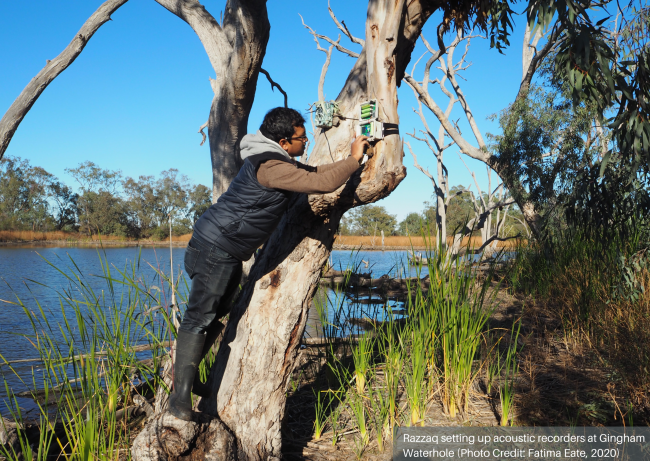
University of New England masters student Razzaq Sarker’s scientific paper on the effect of inundation on frog behaviour and chorusing has been published and is now available to be viewed. Razzaq studied the patterns between inundation and frog breeding of species within the Gwydir State Conservation Area (SCA) and surrounding wetlands.
Kevin, our Warrego-Baaka (Darling) Cultural Advisor, shared with us this song by Leroy Johnson. It delivers a powerful message from Leroy about the Baaka – the lifeblood of the Baakandji people. No Baaka, no Baakandji. Take a listen here
The Gwydir River Selected Area Flow-MER project monitors six scientific ‘indicators’ to help us understand the impact of water for the environment on the landscape, plants, and animals. These include hydrology, waterbirds, fish (diversity and movement), vegetation and food webs. This article covers how we study these indicators and what some of our findings were for the 2021-22 water year.

Have you ever wondered how the Gunambaay (Waterbird) surveys get done, or even what the experience is like? That is what I wondered before I got the chance to go out to the Gwydir Wetlands State Conservation Area in March for the end of the colonial waterbird mass breeding event. May you get a taste for the marvel that are the Gwydir and the Gunambaay that breed there.

We are lucky to work in special places like the Toorale State Conservation Area. Here are some of our favourite photographs we’ve taken over the eight years of the Long Term Intervention Monitoring (LTIM) and Flow-MER programs in the Warrego Selected Area. We hope you enjoy!

We count ourselves lucky to work in beautiful places like the Gwydir Wetlands State Conservation Area. Having been visiting these sites for just over 8 years now, we had a flick through the photo albums and selected a handful of our favourites to share with you. Enjoy!